Some notes on Unforgiven

I spend a lot of time thinking about movies, and most of that time ends up orbiting a handful of films. One of the ones that plays in my head constantly—rewarding me with new insight long after the credits rolled the first time—is Clint Eastwood’s masterpiece, Unforgiven. It’s the best film he’s directed and the best performance he’s given, and like the greatest westerns, it’s far more than entertainment.
At its surface, it’s the story of a reformed man with a violent past who’s pushed by desperation back into the world he tried to leave behind. He finds himself planning to kill for money. But Unforgiven stands out even in a genre already rich with meditations on American masculinity. It doesn’t just compare favorably to The Searchers, The Wild Bunch, or High Noon—it deepens them. It adds texture and color to their central questions. It’s an essential film, in the literal sense: Unforgiven becomes part of how you understand movies.
The plot to kill sets off a crisis of identity for William Munny, Eastwood’s character. This is a man who once killed thoughtlessly, fueled by whiskey and impulse. Later in life he had met a woman who treated him with a compassion he didn’t think was meant for him. She helped him understand that he’s more than the sum of his worst choices—that he could become better, not just behave better. It’s a classic modernist idea, and a true one: men want partners who can see the good in us even when we’ve been clumsy, angry, or lost. We want to feel redeemable.
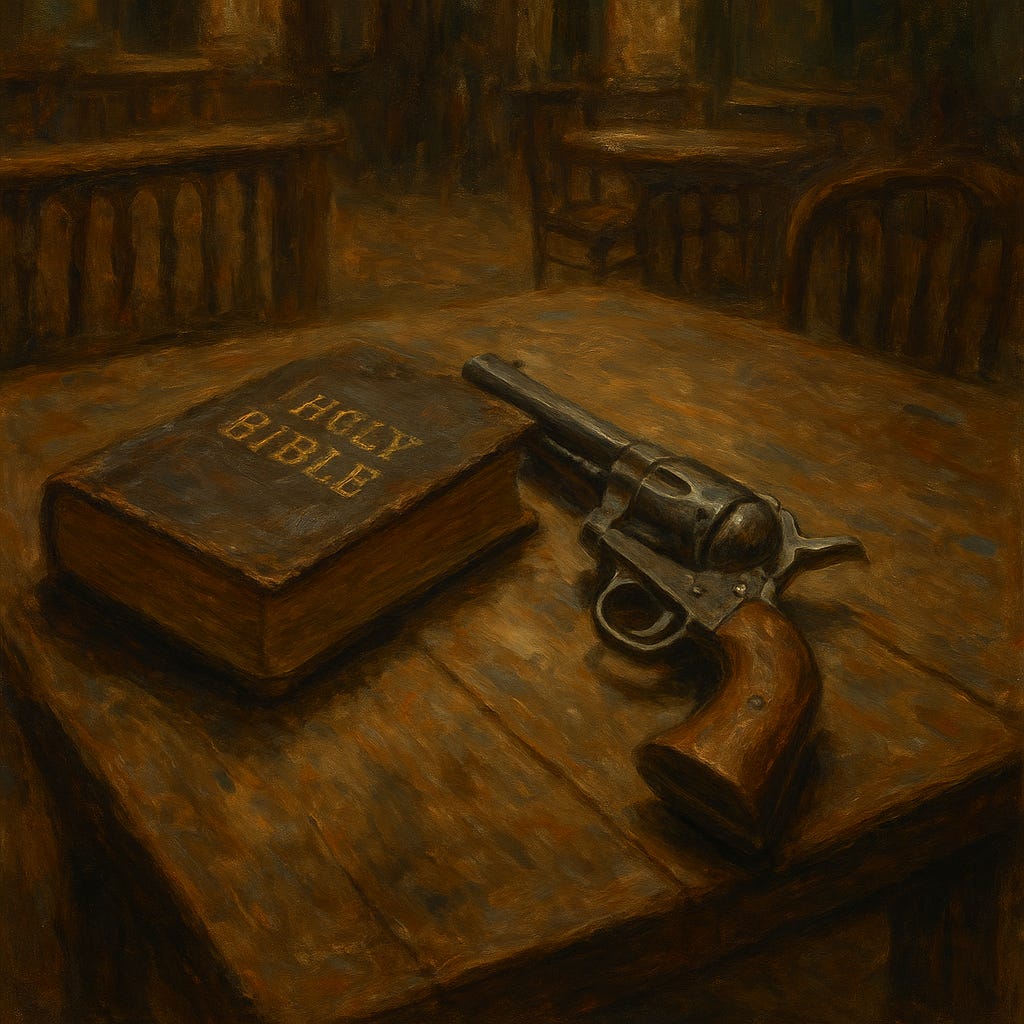
When the movie opens, that woman has died. Munny is suspended between two selves: the violent young man he used to be and the gentle husband and farmer he tried to become. The trouble is, he doesn’t fully believe in that second version. His quiet life functions more like a sentence than a transformation—penance for the man he once was. In that way, the goodness he’s clinging to is still defined by the evil he’s trying to flee.
As Munny and his companions ride out to claim the bounty, the film becomes a meditation on what drives men to violence. Munny isn’t the only dangerous man on the trail, but he’s the only one who carries the weight of it. The journey forces him into a personal reckoning: he’s capable of inflicting suffering, and he’s capable of feeling it, and neither side lets him rest. When the moment finally comes, he actually steps aside from the bounty killing. But when his friend is murdered by a brutal lawman, he understands instantly—and without illusion—that the lawman must die.
But what matters isn’t that choice. What matters is how it’s carried out.
Munny walks into the saloon where the lawman is celebrating and announces what’s coming: “Any man don’t want to get killed better clear out the back.” It’s the most revealing line in the film. This is not the wild murderer of his past, nor the hollowed-out penitent he’s been laboring to become. This is the true William Munny: a man who does not kill lightly, but does not lie to himself about who he is when something hard needs to be done. For the first time, he isn’t split between identities. He’s whole.
Most of us will never face a decision that involves violence, and we shouldn’t. But violence works in movies because its stakes are instantly legible. In reality, the crossroads we face are quieter: leaving a job that’s crushing us, ending a relationship that’s been allowed to decay, parting ways with friends we no longer recognize. We worry about what these choices say about us. We worry that doing the hard thing means we’ve somehow failed to become the person we hoped we were.
But sometimes a man finds himself at his own William Munny moment—standing in the doorway of something he’d rather avoid, knowing it has to be done. And when we make that choice, and live with its consequences, we often discover that the thing we were running from is exactly the thing we were looking for.